ABL chief on mid-life opportunity
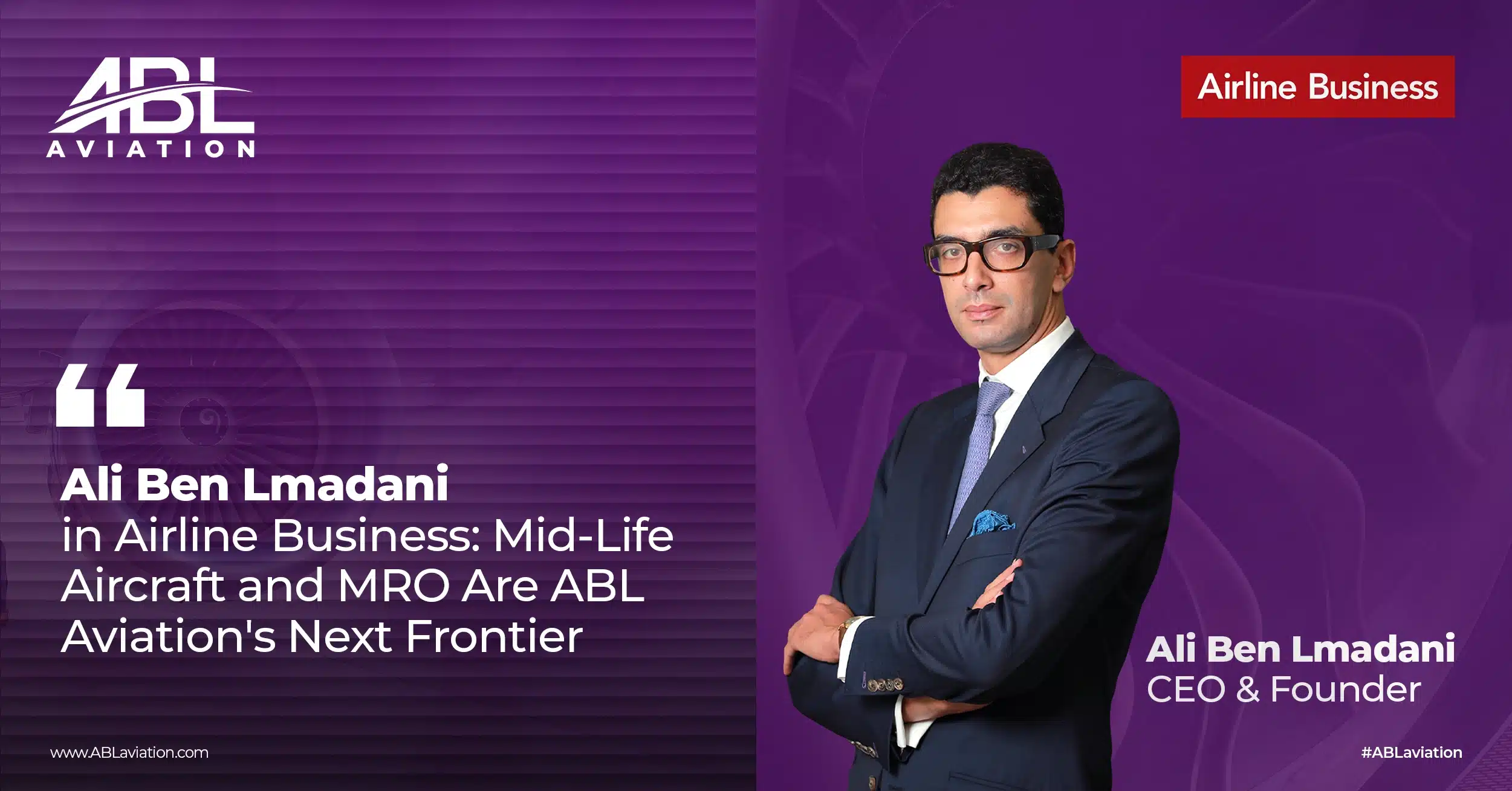
ABL Corporation founder and ceo Ali Ben Lmadani was interviewed by Graham Dunn for the March 2026 edition of Airline Business magazine, featured in the Briefing International section. In the interview, Ali Ben Lmadani shares his outlook on the mid-life aircraft leasing market, ABL Aviation‘s growing MRO capabilities, and the key challenges shaping the aviation industry today. Read the full piece below:
Growing lessor adding MRO capabilities to help support older aircraft types as supply shortage continues
ABL Aviation founder and chief executive Ali Ben Lmadani sees the ongoing shortfall of available aircraft to meet airline demand as driving leasing opportunities for mid-life aircraft. The fast-growing lessor is positioning itself to capitalise on the opportunity for the mid-life and, ultimately, end-of-life aircraft segment by stepping up its own maintenance, repair and overhaul (MRO) capabilities.
The shortage of available aircraft in part reflects the full orderbooks at Airbus and Boeing, meaning delivery of any new orders placed by airlines today would not begin arriving until the next decade. That comes as the OEMs are still catching up on deliveries as their post-pandemic production ramp-up continues.
Ben Lmadani says there is an improving picture on deliveries of new widebodies, but delays remain on Airbus and Boeing narrowbodies – though he notes things are catching up on the A220s.
This shortfall in getting new aircraft combines with airlines still feeling the impact of heightened engine maintenance and supply chain issues.
It is against this backdrop that Ben Lmadani sees increased airline demand for mid-life aircraft – those aged between seven and 18 years old.
“We’re still doing lots in the new [aircraft] market,” he explains, “but we see a lot of opportunities in mid-life [aircraft] and a lot of opportunities in the MRO market.”
He says that while those airlines that can acquire new aircraft will do so, many will turn to mid-life aircraft extensions over the coming years to meet their capacity needs.
Ben Lmadani also then sees increased focus from 2030 on end-of-life aircraft, and to support this market ABL has been developing its own maintenance capabilities. Its technical arm ABL Industries is setting up its first MRO facility in Casablanca, Morocco, which is set to open in the fourth quarter of this year.
“You’re going to have a big shortage of MRO [capacity],” he says. “That’s why you see more and more airlines invest in MROs, because they don’t want to be dependent on third-party MROs.”
MORE MOVES
Consolidation moves within the leasing sector continued in February when Middle East lessor Dubai Aircraft Enterprises (DAE) disclosed plans to acquire Macquarie AirFinance. The deal would take the aircraft portfolio of the combined business to over 1,000 aircraft.
Ben Lmadani expects the difficulties in securing new aircraft will continue to drive consolidation in the leasing market, but sees ABL’s own growth more likely to come through portfolio additions rather than acquiring rivals.
“Never say never, but I don’t see value in acquiring competitors,” Ben Lmadani says. “In my view, it’s very hard to consolidate two platforms with two different cultures and two different ways of thinking.”
ABL Aviation has been rapidly growing. As of the end of 2025, the lessor had deployed over $7.3 billion and completed 116 aircraft transactions – laying claim to being the 24th biggest aircraft lessor by fleet value.
It last year completed Airbus A220-300 deliveries under a 15-aircraft mandate with Air France, additional Airbus A321neo transactions with Turkish carrier Pegasus Airlines, a first Boeing 737 Max 8 delivery under a new six-aircraft mandate with Copa Airlines, and multiple Airbus A350-900 deliveries to Emirates. Most recently, it delivered the second of a pair of Boeing 737 Max 8s to European leisure operator TUI.
He sees continued opportunities for growth from sale-and-lease-backs.
“There’s a lot of appetite from airlines for the highest price,” he says, noting it is attractive for airlines that placed orders several years ago when the price was below the current market value. “It’s a very competitive market, but we are very active in it.”
CHANGED ECONOMICS
While the aircraft shortage has seen airlines hold on to older aircraft for longer as a way of mitigating a lack of available capacity, the surge in oil prices since hostilities broke out in the Middle East at the end of February could change the economics of operating older aircraft.
But Ben Lmadani notes there is a limit to what airlines can do to meet their capacity needs. “If they get rid of the older aircraft, how are they going to get new ones? Airbus and Boeing are not able to supply them. So I don’t think they will [return older aircraft] because most of the airlines need the capacity.
“The biggest issue I think you will have in the next few weeks and months is about the cost of fuel,” he adds, noting this roughly accounts for around a third of airline costs. “You’re going to have people that have hedged their fuel and people who didn’t hedge the fuel, and whoever didn’t hedge their fuel, they’re going to have big issues.”
While headquartered in Dublin, ABL last year opened an office in Dubai – it’s sixth global location – and is set to open its new Africa headquarters in Casablanca in the second quarter. This forms part of ambitions to develop the business in this region. ■
Go Back